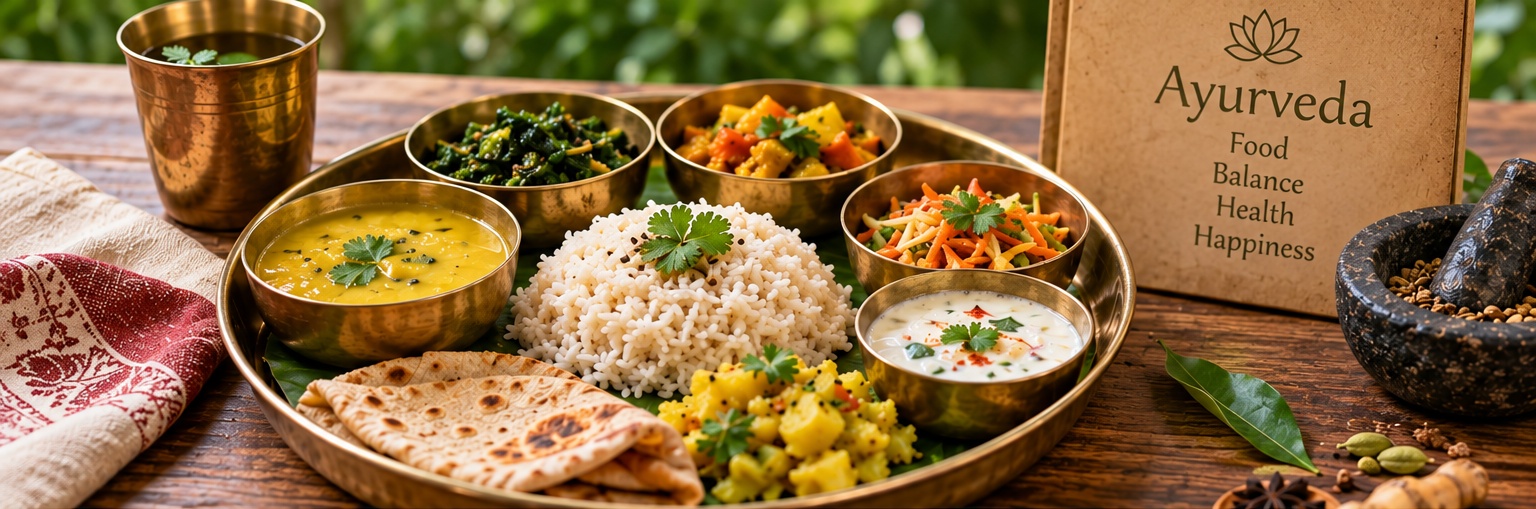
Ayurvedic cuisine is based on rice, legumes and vegetables,
but its true richness lies in spices.
Aromas are never combined at random, but according to their
particular properties: digestive, tonic, disinfectant and therapeutic.
Ayurveda teaches that every individual has the power to heal themselves.
In this way, it offers everyone the possibility of restoring health
through an understanding of their own body and its needs.
According to Ayurveda, in order for an individual to maintain good health,
following a balanced diet and a stable, healthy routine is essential.
The practice of traditional disciplines such as yoga and breathing
exercises is also important, together with an understanding of those
spiritual practices that can create harmony and happiness.
The diet should be adapted to the individual constitution.
By understanding one's constitution and its relationship with
different foods and quantities, it becomes possible to select
an appropriate diet.
The taste of food (sweet, sour, salty, pungent, bitter or astringent)
should be taken into consideration, as well as whether the food
is heavy or light, heating or cooling, oily or dry, liquid or solid.
The seasons of the year should also be considered when choosing a diet.
It is food that nourishes the body, mind and consciousness,
and therefore the way in which we eat is very important.
According to tradition, when sitting at the table we should sit upright
and avoid distractions such as television, conversation or reading.
Focus your mind on the taste of the food and be aware of it.
Chew with love and compassion and you will clearly experience its flavours.
Taste does not originate from food, but from the experience
of the person who eats it.
Agni is the fire of digestion, the digestive enzymes.
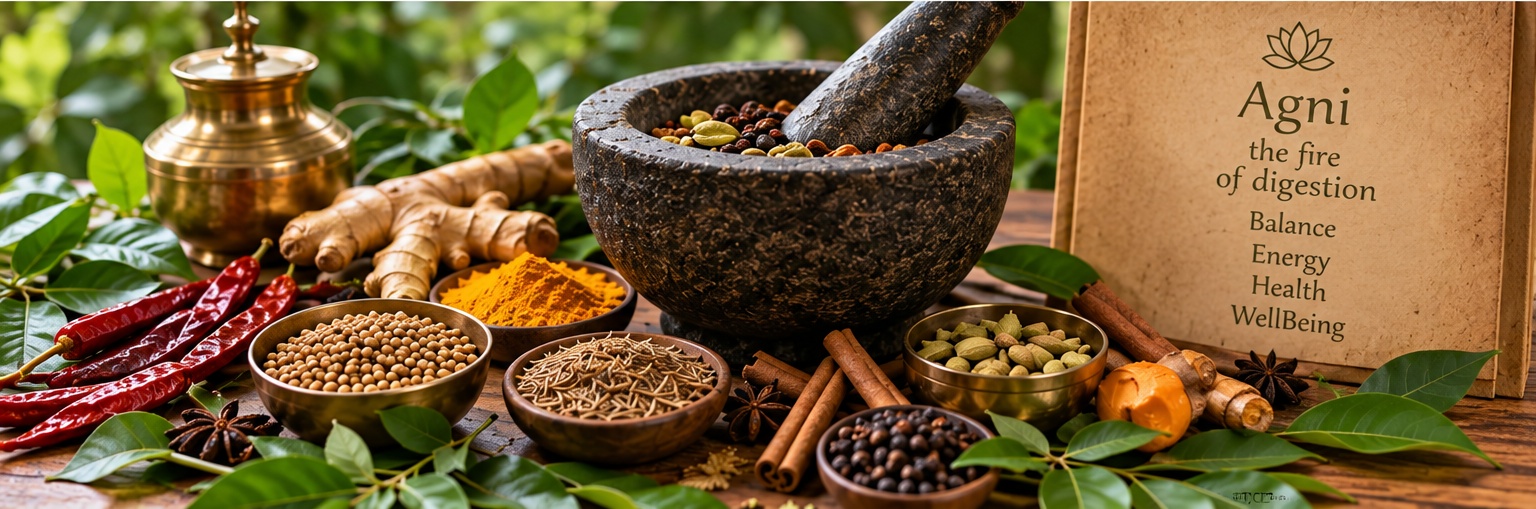
If your Agni is impaired, you will not taste food properly because
the perception of taste depends on Agni. Spices help stimulate Agni,
as well as purifying the body and enriching the flavour of food.
The amount of food consumed in a single meal is also important.
One third of the stomach should be filled with food, one third
with water and one third with air. Eating too much also causes
additional toxins to form in the digestive system, and food
becomes a poison that the body must struggle to eliminate.
We should eat and drink with discipline and regularity,
because eating is meditation. Eating in this way will nourish
your body, mind and consciousness and will also contribute to longevity.
Water plays an important role in maintaining the balance of the body.
Water can also be taken in the form of fruit juices, although these
should not be consumed during meals; water, on the other hand,
is necessary.
A balanced diet, in the Ayurvedic tradition, is not expressed
in terms of fats, carbohydrates, proteins, calories, vitamins
or minerals, but rather in terms of body tissues, water and salt levels,
Rasas,
or tastes and qualities of food,
Doshas,
or vital energies,
Gunas,
or properties of food, and Sadhana (meditation), meaning the body's
disposition towards assimilation.